July 2026 — the entire x2y suite is now free. Code Leak Detector moves to a one-time $29 on 1 Sep.

View products

Scan & Detect Exposed Secrets in Code

Code Leak Detector

v2.0.5

Desktop application that scans your entire codebase for accidentally exposed secrets — API keys, tokens, passwords, and other sensitive data. 200+ detection patterns with 100% offline processing.

WINDOWS 10/11200+ PATTERNSREAL-TIME WATCHZERO TELEMETRY
FREE UNTIL 1 SEPTEMBER 2026
$0 — FREE TODAY
--
Days
--
Hours
--
Minutes
--
Seconds

After 1 Sep 2026: one-time $29 licence. No subscriptions, no recurring fees, no account required.

Code Leak Detector v2.0.5 security dashboard showing scan history with risk analysis, detected secret findings with masked values, severity tags and intelligent filtering controls
CODE LEAK DETECTOR v2.0.5 · SECURITY DASHBOARD · RISK ANALYSIS & SCAN HISTORY

Key features

Find secrets before they leave your disk

200+ detection patterns covering all major platforms

AWS access keys, GitHub tokens, Slack webhooks, Stripe secret keys, Google API credentials, private RSA/EC keys, JWT secrets, database connection strings, npm tokens, PyPI credentials and hundreds more — all matched locally against an offline rule pack.

100% offline — no data leaves your machine

Every scan runs entirely on your hardware. Source code, detected secrets, scan reports and rule packs never touch the network. There is no cloud analysis tier, no "send for deeper inspection" option, no telemetry pipeline. Verify with any network monitor.

Real-time file watching with instant alerts

Point the watcher at a working directory and receive instant notifications the moment a new secret is written to disk. Catch the leak at the keystroke — before it is staged, committed, or pushed to any remote.

Entropy-based secret detection for custom patterns

Beyond pattern matching, the entropy analyser flags high-randomness strings that look like secrets even when they do not match a known pattern. Catch obfuscated keys, rotated tokens and novel credential formats that rule-based scanners miss.

Advanced capabilities

Beyond pattern matching — enterprise-grade secret scanning

Third-party scanner integrations (Gitleaks, TruffleHog)

Run Gitleaks and TruffleHog rule sets alongside the native engine from a single interface. Combine detection strategies without leaving the application or managing separate toolchains. Results are merged, deduplicated and presented in a unified report.

Deep scan mode for binaries and archives

Secrets hide in compiled binaries, compressed archives and embedded resources. Deep scan mode unpacks ZIP, 7Z, TAR, GZ and JAR files in memory, inspects binary strings and extracts credentials that surface-level scanners never reach.

Learning mode to manage false positives

Mark a finding as a false positive and the learning engine suppresses identical patterns in future scans — per project, per file, or globally. The allowlist is stored locally and never shared. Tune the scanner to your codebase without losing coverage.

Secure memory handling for sensitive data

Detected secrets are held in protected memory regions and masked in every output — the UI, the report, the clipboard. Full values are never written to log files, temporary directories or swap. When the scan ends, the memory is zeroed.

Specifications

Technical details

Code Leak Detector specifications
ProductCode Leak Detector
Versionv2.0.5
PlatformWindows 10, Windows 11
Detection patterns200+ (offline rule pack)
Detection methodsPattern matching + entropy analysis
IntegrationsGitleaks, TruffleHog rule sets
Deep scanBinaries, ZIP, 7Z, TAR, GZ, JAR
Real-time watchFile system watcher with instant alerts
Learning modePer-project, per-file, global allowlists
ReportsJSON, SARIF, CSV — CI-compatible
Pre-commitSupported via CLI hook
Memory safetyProtected regions, zeroed on exit
Processing100% local — no cloud relay
Telemetry0 bytes — verified continuously
Account requiredNone — ever
PriceFree until 1 Sep 2026, then $29 one-time
Developerx2y Devs Tools Ltd, Nairobi, Kenya

Quick start

From install to first scan in four steps

  1. 01

    Install

    Download from itch.io. Run the installer — no administrator privileges required for standard installs. No account creation, no activation key. Free until 1 September 2026.

  2. 02

    Point it at a repository

    Select a working tree, a specific path, or an entire drive. Choose standard or deep scan mode. Enable Gitleaks or TruffleHog rule sets if desired. The rule pack loads from disk — no network fetch.

  3. 03

    Review findings

    Findings appear in the dashboard with masked values, severity tags, file paths and line numbers. Use intelligent filtering to triage by risk level. Mark false positives to train the learning engine.

  4. 04

    Export and remediate

    Export the report as JSON, SARIF or CSV for your CI pipeline. Rotate exposed credentials immediately. Use the pre-commit hook to prevent future leaks from reaching version history.

CLIcld scan ./repo --rules strict --format sarifindexing 1,204 files ......... donematching 200+ patterns ....... offline pack 2026-06findings ..................... 2 (masked) src/deploy.ts:88 api_key ****…xyz123 [high] .env.bak token ****…9f41aa [med]✓ report saved locally · cld-report.sarif · 0 B sent

Downloads

Get Code Leak Detector v2.0.5

Free until 1 September 2026. Download now at no cost. After 1 Sep 2026, Code Leak Detector moves to a one-time $29 licence. Copies obtained during the free period continue to work indefinitely.

Changelog

Release history

JUN 2026v2.0.5

Expanded rule pack to 200+ detection patterns. Entropy-based secret detection for custom and obfuscated patterns. Gitleaks and TruffleHog rule set integration. Deep scan mode for binaries and compressed archives (ZIP, 7Z, TAR, GZ, JAR). Learning mode with per-project, per-file and global allowlists. Real-time file watcher with instant alerts. Secure memory handling with zeroed buffers on exit. SARIF and JSON report export for CI pipelines. Pre-commit hook support.

2026v2.0.0

Report engine rewrite. Intelligent filtering by severity, file type and pattern category. Scan history with trend analysis across multiple runs. Masked value display in all outputs. CSV export added alongside JSON.

2025v1.x

Initial release. Core pattern-matching engine with 80+ rules. Basic scan and report workflow. Manual scan only — no file watcher.

Security model

Your source code and its secrets never leave your machine

Data policy. Telemetry: 0 bytes collected. Account required: none, ever. Source access: only directories you explicitly select. Detected secrets: masked in all outputs, held in protected memory, zeroed on exit. Rule packs: bundled locally, never fetched. Cloud analysis: none — every scan runs on your hardware. Licence: free until 1 Sep 2026, then $29 one-time.

Code Leak Detector reads the files you tell it to scan — that is its function. It does not transmit source code, detected secrets, scan reports, file paths, or any other data anywhere. The rule pack is embedded in the installer and exists entirely on your filesystem. Detected secrets are masked in every output surface — the dashboard, the report, the clipboard — and held in protected memory regions that are zeroed when the scan completes. There is no cloud analysis tier, no "send for deeper inspection" option, no analytics SDK, no crash reporter. Verify with Wireshark, Fiddler, GlassWire or your firewall logs — you will observe zero outbound connections.

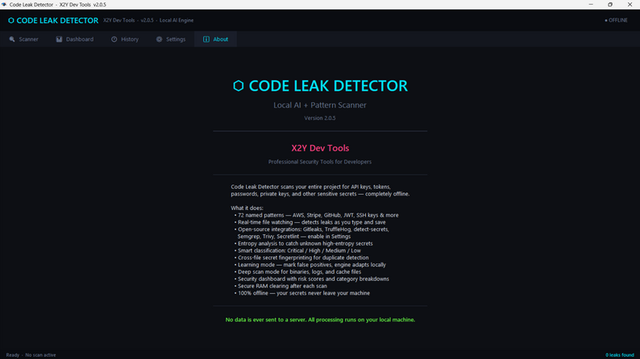
Security manifest
Telemetry0 bytes collected
AccountNone required — ever
Source accessOnly directories you explicitly select
Detected secretsMasked in all outputs, zeroed on exit
Rule packsBundled locally, never fetched
Cloud analysisNone — all scans local
NetworkZero outbound connections
VerificationAny network monitor

Ready to scan

Download Code Leak Detector — find secrets before they ship

No account. No telemetry. No cloud. Just a fast, thorough scanner that catches exposed credentials at the keystroke — entirely on your machine.

Summary
Versionv2.0.5
PlatformWindows 10 / 11
PriceFree until 1 Sep 2026
Telemetry0 bytes